• Imagen 1 Ferrari Reveals 599X Concept
    Ferrari's 599X concept draws on new technology to become an extreme track star. Just like Aston Martin's One-77, this Ferrari went on a diet to reduce engine weight as well as the weight of other components.

Lambo Murciélago LP 670-4 SuperVeloce Stomps Into Geneva

The Lamborghini Murciélago LP 670-4 SuperVeloce charges into Switzerland, bringing all of 670 hp in a lightened chassis to the Geneva Motor Show. A power-to-weight ratio of 5.1 lbs. per hp and all-wheel drive mean a 0-60 mph sprint in just 3.2 seconds on the way to a top speed of 212 mph.

The LP 670-4 is being produced in an exclusive run of just 350 vehicles, and they say that "distinctive design refinements" will proudly shout this exotic's abilities to the world.
A new front and rear grace the vehicle, as do an "innovative engine bonnnet" and a choice of rear spoilers both big and small. Carbon fiber and Alcantara inside match the exterior's bespoke design.
Reductions in weight were achieved by an extensive re-working of chassis, engine, transmission, and interior. And the 30 hp gain in the engine room was achieved by altering the valve timing and bettering the engine's breathing through the intake system.
President and CEO of Automobili Lamborghini Stephan Winkelmann proudly calls the new Murciélago LP 670-4 SuperVeloce "more extreme and uncompromising than virtually any other automobile" and promises that the small collection of potential owners should enjoy a driving experience nonpareil.

This article is one of the last of Geneva Auto Show.


Opel Ampera preview

Opel has released a teaser sketch of its new five-door extended-range electric car ahead of its public debut at the Geneva Auto Show in March.
Based on the Voltec powertrain and chassis architecture of Chevrolet's Volt, the Ampera promises to surpass that car in terms of style by some margin. The body appears to be nearly identical between the A- and C-pillars, but the deformed horseshoe-shaped headlamp design and two-bar grille come straight from the 2007 Flextreme concept, as do the car's tree-branch alloy wheels. Sadly, the Ampera prototype will feature a conventional rear hatch rather than the Flextreme's novel two-piece gullwing design

MITSUBISHI I MIEV SPORT AIR

Mitsubishi Motors will reveal a new i MiEV Sport Air concept at the 79th Geneva International Motor Show in March.

Using the same nomenclature as the Saab 9X 'Air', the new car is an open top variant of the i MiEV Sport design study first unveiled at the 2007 Tokyo Auto Show.

Like its hardtop counterpart, the two-door concept has a bold, wheels-at-each-corner stance and accentuated fenders, while chiseled body lines guide airflow to cool the rear-mounted electric motor. Above the cabin, a 'clear cutaway' roof (with integrated solar panels) is said to enable the driver to 'enjoy the exhilaration of fresh-air motoring while also highlighting its eco-friendly qualities', according to the Japanese automaker.

Claimed to emphasize exhilarating driving pleasure by providing a balance between environmental and dynamic performance, the car has a lithium-ion battery pack mounted in the floor for a lower center of gravity. It measures 3450mm long and has a 2550mm-long wheelbase.


ROLLS-ROYCE 200EX


This is the new Rolls-Royce saloon, a car referred to internally as ‘RR4’, and one that will see production in 2010. It will be at this year’s Geneva Motor Show.

The 5.4m-long four-door is likely to utilise the latest BMW 7 Series platform and will be powered by what the company describes as a ‘new V12’. The innovative forward-opening rear doors of the Phantom are carried over to the smaller (by 435mm in length, although only a touch narrower) car.

Rolls-Royce has traditionally used the ‘EX’ suffix to signify experimental models. Since its incorporation into the BMW empire, the now Goodwood-based company has launched EX models at shows that were, in effect, production-ready advanced prototypes. 100EX debuted at Geneva in 2004 and was then officially launched in Detroit in January 2007 as the Phantom Drophead Coupé.

Like all Goodwood Rolls, it does look impressive. The famous radiator has become less ‘Parthenon’ and is now seamlessly morphed into the bonnet and front of the car. 200EX will carry a silver satin finish applied to the bonnet and A-pillar, similar to the brushed aluminium of the Coupé and Drophead Coupé. The paint on this experimental model is Darkest Tungsten – a classic colour that contrasts nicely with not only the satin silver bonnet, but also the natural grain Crème Light leather interior. Cornsilk carpets complete the luxurious effect.

One of the best aspects of the car is the rear. If you tend to consider Rolls-Royce as a manufacturer of luxurious, superbly appointed and finished limousines - you may have to reconsider. Like the two-door Phantoms, the 200EX has a sporting intent and looks aggressive, with broad haunches covering 285/40 R 20in rear wheels and tyres.

The dashboard is clear and simple, with the trademark thin-rimmed steering wheel. The cabin will be airy for the occupants yet, as in the Phantom, allowing a degree of privacy not found in similar cars.

No price has been mentioned, but most commentators would estimate a UK price of in the region of £170,000 – 180,000.


The Bugatti Veyron EB 16.4 “Pur Sang” Edition

Visitors to the Atelier in Molsheim are always intrigued to see the Bugatti Veyron's high-tech components being meticulously assembled into an automotive work of art. Watching the car coming together, coupled with an admiration for the technical beauty of its structure, gave the designers the idea of finishing the car in its pure material configuration - meaning no color coating. The result is the EB 16.4. Veyron "Pur Sang", a two-tone study of pure materialness showing the car's true essentials: carbon and aluminum.

The carbon monocoque holds the engine plus the passenger cell, while the polished aluminum panelling is enhanced by reflections in the sculpted bodywork. Interestingly, the rawness of the materials even more strongly highlights the dual character of this car: performance power coupled with cruising comfort, structure and body, dark and light.

A closer look at the details reveals the technical logic behind this stylistic appearance. The sophisticated monocoque contains all the core structural components, including the W16 engine, the passenger cell, the crash box and the linkages to the wheels. It is this purpose-driven fundament that is visible as the center of the car in clear-coated carbon fiber.

Equally consistent is the use of the aluminum paneling. This lends shape and a unique body sculpture to the car, covering the wheels in a muscular and powerful expression by way of elaborately shaped fenders. Highly polished, these perfectly tensioned shapes strongly visualize the fascinating surface reflections that define every Veyron.

The balanced graphic appearance is also visible when looking down onto the car from above. These qualities take on a distinct appearance - almost like that found in a Mondrian painting. As its pur sang label suggests, this individualized customer car shares the same kind of DNA as that of classic cars from the Bugatti past: the "Atalante", the Type 55, the Type 41 "Royal" all had an unmistakable and characteristic graphic signature. It is this precise division of performance components and body paneling - in this form - that makes the EB 16.4. Veyron "Pur Sang" unique in the supercar world.

Ferrari Reveals 599X Concept Details At Geneva Motor Show

Based on the 599 GTB Fiorano, Ferrari's 599X concept draws on new technology to become an extreme track star. Just like Aston Martin's One-77, this Ferrari went on a diet to reduce engine weight as well as the weight of other components.

The engine uses carbon fiber pieces in the intake system and pieces like a lighter crankshaft to reduce the volume of material used for engine manufacturing. As well, combustion chambers and airflow systems have been redesigned to increase redline to 9,000 rpm. And also like the Aston, power levels are quoted at 700 hp or thereabouts.

"High Performance Dynamic Concept" is a newly-designed electronics suite meant to wring max performance from the 599X concept's chassis by "managing the combination of the car's mechanical limits with the potential of its electronic controls." It comes into effect on the track to achieve best possible lap times. Increasing mechanical limits is a new suspension dubbed SCM and custom tires. And F1-style "doughnuts" provide extra brake cooling as well as improving aerodynamics.
Extra downforce, engine bay heat vents moved to the front of the car, and underbody fairings covering the front underside fully improve aerodynamics across the board. An "Actiflow" system increases downforce as well as cutting drag by using a novel porous surface for spoilers and the diffuser.

Zagato Perana Z-One

Zagato will unveil a concept called the Perana Z-One at the Geneva Motor Show next week, commemorating the company's 90th anniversary. With a long hood and short rear deck, the supercar has been given proportions befitting a grand tourer.

Though the coachbuilder has not provided much information on the two-seat concept, the gaping oval grille and large air intakes above the sill and below the shoulderline indicate the car is powered by a large front-mounted conventional powerplant. Large vertical headlamps flank the hood, which features still more mesh-covered air outlets for dissipating heat. In profile, the concave fender morphs through the door to become a pronounced rear haunch. The grille's shape is also repeated at the rear on a broader scale, as is the headlamp design, with smaller circular lamps encased within the taillamp housing. The concept's double bubble roof, flowing from the steeply raked windscreen through to the backlight, is also a definitive Zagato design element.

We'll bring you additional details once we see the Perana Z-One in the metal at the Geneva Motor Show next week.

Citroen DS Inside

The DS naming is part of a new brand strategy for Citroën. The idea is that these ‘Distinctive Series' cars could come to be seen as the next step on from over-hyped premium cars, thus more in keeping with today's zeitgeist and thus a 3 model sub-brand range will be offered encompassing DS3, DS4, DS5.

The DS Inside is the preview of the forthcoming DS3 model likely to be revealed at Frankfurt Show in September, a Mini Clubman-sized two-door wagon, based on the C3/Peugeot 207 platform.

Two versions have been produced: the ‘alluring' version released in the original press images with dark brown bodywork and a metal-flecked roof and a second ‘dandy elegance' version seen here at the show with deep grey color and contrasting bright pink roof and rearview mirror housings.
Although it's called DS Inside, the interior was the one part of the car that was not available for viewing, Citroën preferring to keep that part of the story for the later production launch. However we can confirm that the DS Inside model was fully production-ready, complete with pressed panels, wipers and glass seals, so there will only be detail changes for the DS3. In addition, viewing the car wasn't easy, as it was presented in a darkened room behind the main booth, with low levels of colored lighting that made photographing the dark grey car very difficult.
Seen from the side, the most notable feature is the way the shoulderline is terminated behind the door and turns up into the kicked-up B-pillar treatment, meant to resemble a shark's fin. At the front, the vertical gills on either side of the big chrome trapezoid grille continue this shark theme of the design. Overall, the new DS Line is a promising development and we look forward to seeing the finished result later this year.

2011 Mercedes-Benz SLS AMG


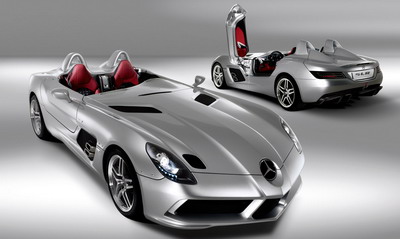
The marriage between Mercedes-Benz and McLaren has been something of a disappointment. Their co-created product, the SLR McLaren, has never met sales expectations, and its marketers have resorted to increasingly gimmicky special models in order to reach their contractually obligated goal of 4000 total units. There's been the convertible, the 722 edition, and most recently the totally topless, essentially windshield-less, and all but pointless SLR Stirling Moss, which is the final special edition before SLR production shuts down forever later this spring.

With the SLS, AMG for the first time ever is responsible for the development of an entire vehicle, and the new Gullwing is an ambitious, ground-up effort. The car uses an aluminum body draped over an aluminum spaceframe chassis, which is a first for Mercedes-Benz. The extensive use of lightweight metal helps it reach a target curb weight of 3571 pounds. And, of course, the two-seater will use the characteristic gullwing doors, made famous by the Mercedes 300SL more than fifty years ago.


Infiniti Essence concept

Celebrating the 20th anniversary of Nissan's Infiniti luxury brand, the dramatic two-door two-seat Essence concept features classic GT proportions blended with existing Infiniti design elements, pointing to the company's future design direction.

The fruit of a global individual competition, the design was initially penned by designer Aroba Giovanni while at NDA in San Diego California, who has since moved to work at Nissan Design in Tokyo where the concept was refined and developed. Speaking to CDN, product chief designer Mamoru Aoki told us how the concept was inspired by big waves and Japanese brush strokes. "The idea comes from the power of nature," Aoki said, calling the design theme of the complex surfacing "comfortable complexity."

Powerful front fenders lead into the strong, slightly curved body side, which features a pronounced beltline ledge that contours the DLO. When seen in profile, this horizontal element and deep concave undercut bridges the voluptuous surfacing of the body side, emphasizing the front fenders and pronounced rear haunch..
The two-tone interior, created by two designers at Nissan's Japanese studio and a designer at NDE in London, is divided into two very distinct parts: a dark-grey driver-oriented cockpit and the burgundy-colored passenger area.
With its expressive and avant-garde design, the concept certainly pushes the design envelope, yet still manages to be refined and elegant. And its complex convex and concave surfacing, though polarizing, has already been widely accepted by BMW buyers.

Alfa MiTo GTA Concept at Geneva: Small Car, Big Performance

The latest manufacturer to announce an unveiling at next week’s Geneva show is Alfa Romeo. The sporty Italian marque will be displaying a high-performance concept version of its recently launched MiTo.

The MiTo GTA Concept relies largely on weight reduction to produce the best possible power-to-weight ratio – which is all in the best traditions of ‘GTA’, or ‘Gran Turismo Alleggerito’ branding (alleggerito is Italian for lightened).

There’s also been much work done to lower the car’s centre of gravity. Hence the tailgate spoiler, as well as the roof and mirror fairings, are in carbonfibre, while aluminium is used extensively in the braking system, suspension and some parts of the chassis.

Under the bonnet, the compact new petrol engine exploits Alfa’s experience in developing its Twin Spark and V6 road and race engines, with direct injection, dual variable valve timing, state-of-the-art turbocharging and advanced electronic management systems. The combined effect of these technologies is a highly impressive 240bhp from just 1742cc. In this way, Alfa is following the current trend towards high power and efficiency from a smaller, lighter power unit.

The MiTo GTA Concept is 20mm lower than the standard MiTo, with new geometry for the front suspension, while the revised chassis has an ‘active’ suspension system to counteract weight transfer under acceleration, stiffening the rear and maximising traction. Meanwhile, a ‘Sky-Hook’ function aims to give high levels of passenger comfort, despite the sporting aspirations of this desirable Italian hot-hatch.

About Suzuki XL7


The XL7 has a 252 hp V6 3.6-liter, double overhead camshaft, 4-valve-per-cylinder powerhouse of an engine. And with 243 lb.-ft. of torque, new 6-speed automatic transmission with manumatic shift mode, Electronic Stability Program (ESP®), Traction Control System and available electronically controlled full-time AWD, you have the power and traction you need, when you need it—for towing to the lake in the summer and getting up the mountain to the ski resort in the winter.

As the winner of the AutoPacific 2008 "Best in Class Vehicle Satisfaction in the Premium Mid-Size Crossover SUV category," the XL7 excelled. With power and acceleration, braking, handling, traction in all weather conditions and safety features among the highest of many breakthrough scores the XL7 received, owners also gave the vehicle top marks for being fun to drive

With an improved EPA-estimated mpg of up to 17 mpg city and 24 highway, the 2009 XL7 is one of the most efficient SUVs around, but still is equipped with all the creature comforts you desire—and have earned.

Citroën DS Inside concept

Citroën has just unveiled the new DS Inside concept car, one of three new vehicles set to bear the name of their iconic predecessor.

The announcement of the much-lauded nameplate's revival is also joined by a new three-dimensional logo design and an invigorated development plan, which marks the company's 90th Anniversary and the birth date of its founder, Andre Citroën.

The French automaker's new product line takes inspiration from its historic design DNA to strengthen its positioning. Called the DS3, DS4 and DS5, the three new cars will occupy the small, medium and large car segments and be launched successively from 2010. The Inside concept (pictured), which will make its debut at the forthcoming Geneva Motor Show, will likely spawn the upcoming smaller derivation, the DS3.

Aiming to satisfy the needs of customers who are seeking fundamental mobility, prestige, thrills and refinement, Citroën wants to broaden its product portfolio to appeal to those looking to downsize but who still desire intelligent and appealing products. The company claims the 'accessible objects of desire' will stand apart through their creativity, intelligent design and build quality, embodying the 'different spirit' of their ancestor.

Aston Martin DBS Volante

Aston Martin will unveil the new DBS Volante at the Geneva Auto Salon on 3rd March 2009, completing the DBS line-up with this soft-top version. Up or down, the motorised lightweight fabric roof preserves the profile of the DBS, disappearing neatly behind the new tonneau cover. Weight gain has been minimised and the convertible top retracts in only 14 seconds, at speeds of up to 30mph.

The new DBS Volante is Aston Martin’s 16th convertible in the company’s long history and is a 2+2 with the occasional rear seats intended for young people or extra luggage. Although the DBS was originally conceived as a two-seater sports GT, Aston Martin states that a possible Volante version was always in mind.

The all-alloy 6.0-litre V12 engine produces 510bhp and 570Nm (420lb ft) of torque, giving a top speed of 191mph and 0-62mph in 4.3 seconds. In standard form, the DBS has a rear-mounted six-speed manual gearbox, while an automatic six-speed ‘Touchtronic’ option is also available. As with the coupé, the Volante is offered with carbon ceramic brakes as standard, providing exceptional stopping power. The bonnet, front wings and boot lid are made from carbonfibre materials derived from the motorsport and aerospace industries.

The DBS Volante will be built at Aston Martin’s headquarters at Gaydon, Warwickshire, with the first customer deliveries expected to start in the third quarter of this year. Prices will be announced at the Geneva Auto Salon.

Kia cee'd Hybrid in Geneva: 49 mpg, 77 Lb-ft From Electric Motor

Kia is using the Geneva Motor Show to show a version of its cee'd car with a hybrid powertrain; it has produced a fleet of the hybrids for testing and evaluation in Europe.

The cee'd Hybrid makes use of Kia's Gamma 1.6-liter four paired with a 15 kW AC electric motor, a CVT transmission, and Kia's new engine stop/start system (ISG - Idle Stop & Go). Torque for the electric motor is a stout 77 lb-ft, presumably giving the cee'd Hybrid some ultra-efficient electric only acceleration and cruising capability.

Acceleration to 62 mph is a leisurely 11.8 seconds; top speed is approximately 115 mph. Mileage improves by 25 percent over the standard 1.6-liter gasoline cee'd, rising to approximately 49 mpg.

Frazer-Nash Namir by Giugiaro concept

The Namir concept is a joint venture between Giugiaro design and the famous pre-war English sports car company founded in 1923, which has bee specializing in the construction and marketing of hybrid systems since the early 1990s.

Technically it's interesting, featuring a hybrid electric drivetrain comprising an 814cc rear transverse rotary petrol engine coupled with electric motors installed on the front and rear suspensions - developing an overall power of 362bhp - yet has very low emissions of 60g/km of CO2.

From a design perspective it's less impressive, although it's still a striking Italian supercar. A diamond theme dictates the design from all points of view, drawing its inspiration from the historic logo of the Frazer-Nash name. Seen in plan view or side view it works OK, but it's a fairly contrived approach for an all-new brand and the over-use of graphics to define the design leads to a number of functional shortcomings. The diamond-shaped air intakes on the bodyside can be seen as a graphical extension of the pronounced V-shape to the top and base of the screen. However, visibility from the driver's seat is very limited, while the lean-forward B-pillar severely restricts entry, though the little triangular extensions from the doors into the roof seem to be an attempt to redress this.
The interior features brown Alcantara and leather, with baseball stitching used on the seat sides, plus herringbone tweed cloth used on the lower dashboard. Three touch screen monitors are installed behind the hexagonal single spoke steering wheel.
In summary, the Namir disappoints and appears as a collection of old-school Lamborghini ideas: the basic profile, scissor doors, number of intakes, even the orange color. It would have been nice to see a more original styling approach for a newly revived brand.

Eco models of the Geneva Auto Show 2009


Geneva Auto Show will be the chance that auto manufacturers around the world will present over 130 world premieres, as the automotive industry for a few days trying to dispel some of the bleak prospects on its future, inform AGET Associated Press, cited Agerpres. giugiaro environmental technologies will have an important place at the Geneva Show, this area will bereceive an entire pavilion, which will be presented not only cars with low fuel, but also new technologies, ranging from cars to hybrid cars that operate on batteries. Austrian manufacturer Magna Steyr will come with an electric concept. The model is powered by an electric motor only 67 horsepower, which can operate through lithium-ion batteries equipped in almost 150 kilometers. TechArt Magnum is another project famous tuner which will be presented at the Auto Salon in Geneva, the basic car is a Porsche Cayenne Turbo S. Italdesign Giugiaro will present the fastest hybrid concept in the world in the auto salon in Geneva. Giugiaro concept uses a hybrid electric system along with a special engine to generate power for the electrical system.

Infiniti Essence concept

Celebrating the 20th anniversary of Nissan's Infiniti luxury brand, the dramatic two-door two-seat Essence concept features classic GT proportions blended with existing Infiniti design elements, pointing to the company's future design direction.

The fruit of a global individual competition, the design was initially penned by designer Aroba Giovanni while at NDA in San Diego California, who has since moved to work at Nissan Design in Tokyo where the concept was refined and developed. Speaking to CDN, product chief designer Mamoru Aoki told us how the concept was inspired by big waves and Japanese brush strokes. "The idea comes from the power of nature," Aoki said, calling the design theme of the complex surfacing "comfortable complexity."

Powerful front fenders lead into the strong, slightly curved body side, which features a pronounced beltline ledge that contours the DLO. When seen in profile, this horizontal element and deep concave undercut bridges the voluptuous surfacing of the body side, emphasizing the front fenders and pronounced rear haunch. The chrome C-pillar element, which Aoki says will see production in a future model, is particularly interesting as it creates a concave surface aft of the C-pillar that dissipates into the rear deck. In the trunk is a bespoke luggage set created by Louis Vuitton, which extends out of the vehicle on a parcel shelf when the trunk is opened.
The two-tone interior, created by two designers at Nissan's Japanese studio and a designer at NDE in London, is divided into two very distinct parts: a dark-grey driver-oriented cockpit and the burgundy-colored passenger area. Utlizing materials such as Alcantara, traditional leather and horse leather (which gives a technical look to the IP area surrounding the gauge cluster and the center console), the exterior design theme has also been filtered into the cabin. The chrome window switches, HVAC, and audio controls on the center console also communicate the minimalist design approach.
With its expressive and avant-garde design, the concept certainly pushes the design envelope, yet still manages to be refined and elegant. And its complex convex and concave surfacing, though polarizing, has already been widely accepted by BMW buyers.

Lamborghini Estoque

The Lamborghini Estoque is a concept car built by Lamborghini. Unlike current production Lamborghini cars, which are mid-engine two-seat sports cars, the Estoque is a four-door sedan.

The Estoque was introduced at the 2008 Paris Motor Show. The Estoque is the first front-engine vehicle by Lamborghini since the LM002 utility vehicle. Despite being classed as a concept car, the Estoque is being seriously considered for production. It currently houses a 5.2 litre V10 engine, although there has been speculation that this could be replaced by a V12, V8, or possibly even a hybrid or turbo-diesel engine (as suggested by Lamborghini's Brand Director, Manfred Fitzgerald).

As with other Lamborghinis, the Estoque derives its name from Spanish-style bullfighting. An estoque is a type of sword traditionally used by matadors.

Fiat 500C - A World Preview

A worldwide preview of the Fiat 500C presentation will take place at the next Geneva Motorshow, before its launch throughout Europe this spring. Evocative of freedom and emotion, this original 'cabriolet' pays homage to the open-top 1957 model whilst offering leading-edge solutions for mechanical units, powerplants and interior comfort. All this in authentic Fiat tradition giving access to higher segment engineering and technology hitherto unheard of.

Featuring an innovative softtop - a fully fledged window to the sky - the new 500C comes in the same size as the basic model (3.55 m x 1.65 m x 1.49 m) and the same three powerplants: the 1.3 liter 75 HP Multijet Turbodiesel coupled to a 5-speed manual transmission and the two 1.2 liter 69 HP and 1.4 liter 100 HP gasoline engines, available with either manual or robotized Dualogic transmission. Providing different features, all three engine types are generously sized, have a brilliant temperament and offer high performance based on sophisticated technology. Standard features include stubborn reliability and environmental friendliness.

Moreover, as proof of Fiat Automobiles commitment to ecology and sustainable mobility, the new 500C incorporates the innovative “Start&Stop” system, a device controlling momentary engine shutdown and subsequent reignition. To this end, at every stop when shifting to neutral and releasing the clutch, the engine is switched off and then restarted simply by selecting a gear.

The 500C is further proof of Fiat's undisputed leadership in this vehicle class where continuous innovation ensures that its position as the industry's standard is maintained. In fact the car sets new levels of in terms of comfort and safety, engineering and appointments whilst maintaining that unique and inimitable Italian style. A new cabriolet is born which gives great excitement and utmost driving pleasure, combining captivating lines with the performance of flexible, environment-friendly engines.

Lamborghini History

Ferrucio Lamborghini was born during 1916 in a Italian farming village called Renazzo di Cento, Ferrara. He was drafted into the Italian service during World War II where he repaired vehicles. After the war, Ferrucio began building tractors out of his garage using army surplus left behind by the Allied Forces. There was a strong demand for his products and which allowed for him to move into larger facilities. In 1959 the Lamborghini production was extended to burners and air conditioning units. The businesses became so successful that he became one of the wealthiest individuals in Italy.

Ferrucio Lamborghini owned a Ferrari that started giving him problems. The problems could not be solved by the local repair shop so he took it to Modena and confronted Enzo Ferrari himself. Enzo Ferrari, a man known for his arrogance, told Ferrucio that the problem was not with the car but rather with the 'farmer'. After being insulted, Ferrucio decided to build his own GT car.

Automobili Lamborghini SpA was founded in early 1963 at SantAgata Bologna. He used his birth sign, Taurus the bull, as a symbol for his cars. Most of his cars were named in connection with bulls. Giotto Bizzarrini, a former employee of Ferrari was recruited to design and build a V-12 for Lamborghini. The engine was soon completed and produced 400 BHP. Since Ferrucio wanted a GT car and not a race car, the engine was de-tuned to 280 BHP.

In March of 1964, Lamborghini's first production
car arrived and was named the 350 GT. The 350 GT was succeeded by the 400 GT and the 400 GT 2+2. When the Miura was introduced, a true super-car, it was named after a famous bull's race, and this practice became a tradition for the House of the Bull.

During its life time, the company has faced some hardships but has been able to pull through due to breath-taking works-of-art such as the Countach, Espada, and Diablo.

In 1973 Ferrucio sold all of his companies and retired to his vineyard in Italy's Umbria province. He died on February 20, 1993 at the age of 77. The company lives on.

SLR McLaren


Galerie Foto cu Mercedes-Benz SLR McLaren Stirling Moss, bolidul de 750.000 euro!
Fireball is propelled by a V8 engine of 5.5 liters with 650 HP, will be built in limited edition of 75 units.

The new SLR McLaren Stirling Moss will be the last vehicle built by Mercedes in partnership with McLaren, but even at the price of 750,000 Euro I find those 75 customers.

SLR Roadster will cease to be produced at the end of May 2009, and SLR Stirling Moss will start in
June 2009.

The SLR McLaren Stirling Moss has a body full of fibercarbon, and under the hood is an engine surcharge of 5.5-liter V8 that develops 650 HP.

Transmission is ensured by an automatic gearbox with five steps, similar to that of the SLR 722.
Stirling Moss could reach a maximum speed 350 km / h, after an acceleration of 0-100 km / h in just 3.5 seconds.

Bentley Continental Supersport

The wraps are off Bentley’s fastest (204mph) car. The Continental Supersports debuts at the Geneva Salon and will not only be the company’s most powerful Bentley ever, but also its first ‘FlexFuel’ performance car.

FlexFuel means that the 621bhp stripped-out GT will run on either petrol or E85 biofuel (or any combination of the two) and is the first in Bentley’s range to do so, with all cars to be compatible with renewable fuels by 2012. North American Bentleys will be offered with this capability by the summer of 2010, following regulatory approval.

The company states that, "E85 biofuel can offer a reduction of up to 70 per cent in CO2 emissions on a ‘well-to-wheel’ basis". ‘Well-to-wheel’ is "a measurement of a fuel’s net CO2 contribution to the atmosphere, not just tailpipe emissions... a way of quantifying how much CO2 a fuel emits from its growth or extraction (well) to its combustion or deployment (wheel). It includes refinement, distillation and transport of the fuel".


Compared to the already mightily fast, standard GT Speed, power is up by 3.5% and torque - now 800Nm, or 590lb ft - by 6.7%. The ZF six-speed automatic gearbox has been uprated to a ‘Quickshift’ version, reducing gearchange times by a half and allowing the 'box to go down two gears at a time. Various software changes allow throttle ‘blipping’ to match road speed, as well as cutting revs much faster on upchanges.

The suspension broadly f ollows GT Speed practice, although various improvements have been made for the latest Bentley. It will have an electronic stability programme unique to the car.

With its reduced weight, increased power and speedier gearbox, the new car will sprint to 62 mph in just 3.7 seconds. Even more impressive, 0-100m ph is achieved in only 8.9 seconds. Maximum speed is 204mph.

If the interior, with its carbonfibre, Alcantara and new, ‘Soft Touch’ leather is of an altogether more sporting Bentley, the exterior has been only subtly modified.

powered by Speedtospeed Team | WordPress by Mahdahleen | Converted by Mahdahleen